How to Measure Your Penis Without a Ruler (Accurately)
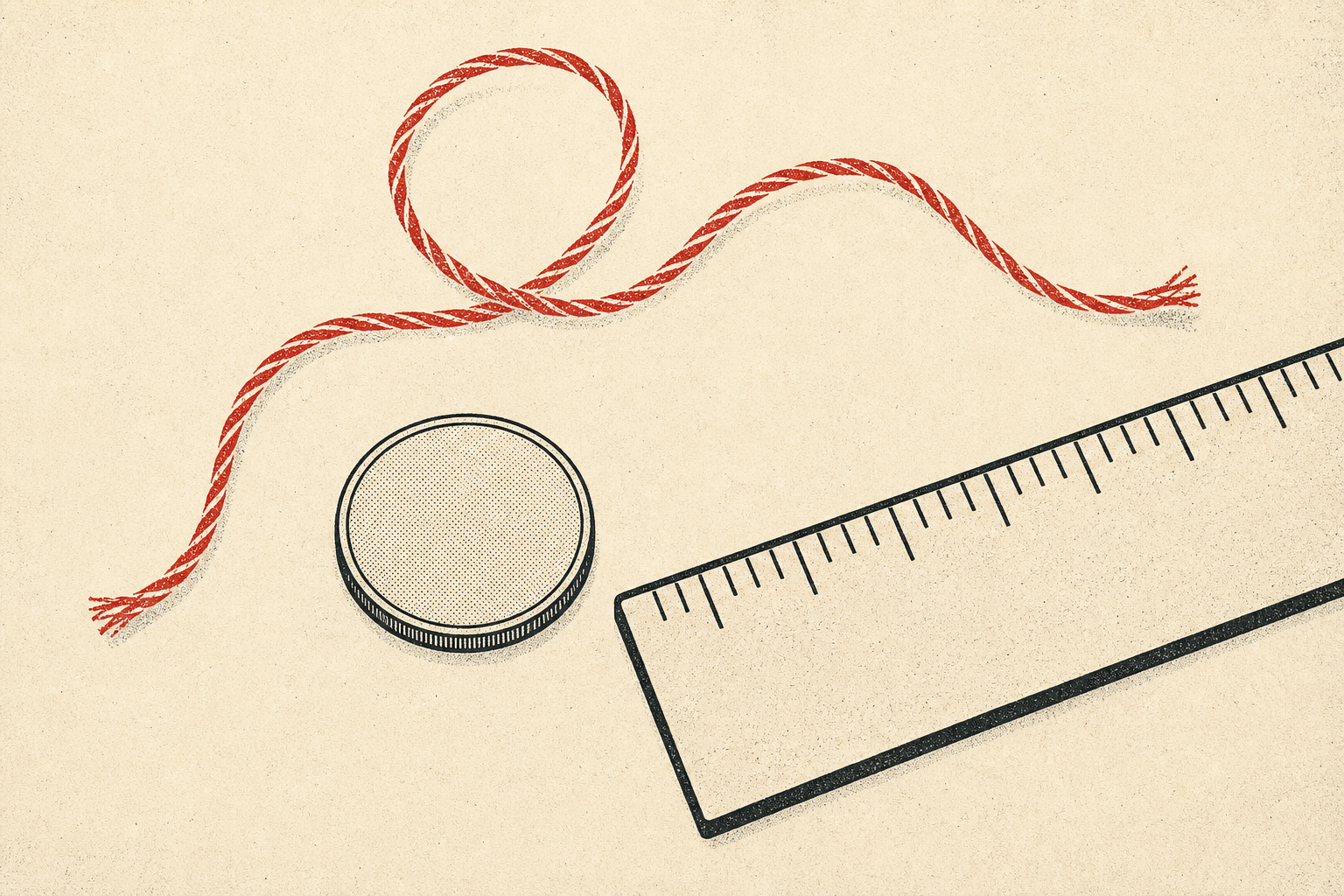
No ruler? No problem. Press a strip of paper along the top of your shaft and mark where the tip ends, or wrap a piece of string for girth, then lay that mark against an object whose size you already know cold. A standard credit card is 85.6 mm wide (8.56 cm / 3.37 in) and a US dollar bill is 15.6 cm (6.14 in) long. Line up your mark, do one quick bit of arithmetic, and your number is every bit as trustworthy as a tape measure.
The ruler was never the point. Measuring the right way and converting honestly is. Here’s how to nail both.
Why a paper strip beats your memory
The mistake most guys make isn’t a missing ruler. It’s eyeballing. You glance down, decide it looks like “about six inches,” and that guess gets baked into how you feel about yourself for years. Eyeballing runs high or low by a full inch in either direction, and you never find out which way you got burned.
A paper strip kills the guessing dead. You’re not squinting at a tiny number on the side of your shaft at an awkward angle. You transfer the length onto a flat strip first, then measure that strip on a table in good light like a sane person. Two separate jobs, each one dead easy. That alone beats the number you’ve been carrying around in your head.
So grab a strip of paper. The long edge of any receipt, an envelope, or a sheet torn into a ribbon all work fine.
The paper-strip method for length, step by step
This is the whole thing. One minute, start to finish.
- Get fully erect. Not mostly. A partial erection reads short and inconsistent, and it’s the single biggest source of a “disappointing” number. Give it a few minutes in a warm room — more on why temperature matters below.
- Stand up and hold the penis out parallel to the floor, pointing straight ahead. Pull it up or let it sag and you’ve changed the reading.
- Press one end of the paper strip firmly against your pubic bone, right where the shaft meets your body, on the top side. Push the strip into the fat pad until it stops at bone. This is the step everyone skips, and it’s the one that makes your number comparable to every chart and study on the planet.
- Lay the strip flat along the top of the shaft to the very tip. Pinch or fold it exactly at the end of the glans.
- Mark that spot with a pen, or just keep your thumbnail on the fold.
- Take the strip to a table, set it next to your reference object, and convert (next section).
That’s length. No contortion, no squinting, no reading a ruler upside down against your own body. The strip does the hard part; the table does the math.
The string method for girth
Length is half the story. Girth matters at least as much for how you actually fill out, and it’s the dimension that decides condom fit. Paper won’t wrap, so switch to string, a shoelace, dental floss, or a phone charging cable.
- Still fully erect, find the thickest part of the shaft — usually the middle, sometimes just below the head.
- Wrap the string once around that spot. Snug, not strangling: flat against the skin, no denting.
- Mark or pinch the string where it meets its own starting end. That overlap point is your circumference.
- Pull the string straight, lay it next to your reference object, and convert exactly like you did for length.
Girth is a circumference, so here’s your benchmark: average erect girth is 11.66 cm (4.59 in). Stretch your string out and you’ll see it runs a fair bit longer than a credit card’s width. That’s normal, and it’s the measurement most men have never actually taken. If condoms are why you’re here, that number is the one that counts — see our condom-fit guide.
The best reference objects (with exact dimensions)
Any object is a ruler if you know its true size. Lead with the credit card, because there’s one in every wallet on Earth and they’re all identical by international standard.
- Credit / bank / ID card — 85.6 mm wide (8.56 cm / 3.37 in), 53.98 mm tall. The gold standard. Every Visa, Mastercard, driver’s license, and hotel key is this exact width. Lay your strip along the long edge: most erect lengths land at roughly one and a half card-widths.
- US dollar bill — 15.6 cm (6.14 in) long, 6.6 cm tall. Nearly ideal, since it’s longer than almost any measurement you’ll take, so your whole strip fits against it in one go.
- A4 paper — 21.0 × 29.7 cm. Tore your strip from a sheet? Then you already know the sheet’s edges are exactly these lengths. A solid backup scale.
- US Letter paper — 8.5 × 11 in (21.6 × 27.9 cm). Same trick for American printer paper.
How to convert: line your mark up against the card’s long edge. Mark falls short of one full card-width? You’re under 8.56 cm. Runs past one card and partway into a second? Add 8.56 to the leftover. Say your mark sits one full card plus about two-thirds of a second card — that’s 8.56 + (0.66 × 8.56) ≈ 14.2 cm. The dollar bill is even simpler: one bill is 15.6 cm, so a mark at roughly 85% of the bill’s length is about 13.3 cm. Round to the nearest tenth and move on.
Bone-pressed, or your number means nothing
This is the detail that separates a real measurement from a flattering one. There are two ways to measure length, and they are not interchangeable.
Bone-pressed (BPEL) means you push the strip into the fat pad until it stops at the pubic bone — exactly what step 3 told you to do. Non-bone-pressed (NBPEL) means you measure from the skin’s surface and leave the fat pad uncompressed. The gap is real: a thicker fat pad can swallow a centimeter or more of shaft, which is why losing weight can “add” visible length without anything actually changing.
Bone-pressed is the honest, repeatable number. It ignores how much padding you’re carrying this month and measures the shaft itself, which is exactly why clinics and studies use it — including the dataset behind every chart on this site. Measure NBPEL instead and you’ll read low and convince yourself you’re below average when you’re not. The full breakdown lives in BPEL vs NBPEL, and the complete clinical technique researchers actually use is laid out in the full how-to-measure method. Press to the bone. Same way, every time.
Accuracy tips that actually move your number
Same method, same conditions, every time. That’s the whole game. A few things matter more than people expect:
- Be fully erect, and don’t measure flaccid at all. Flaccid size swings wildly with temperature, mood, and the last five minutes, and it predicts erect size poorly. It’s the least useful number you can take. Flaccid vs erect explains why the soft measurement is basically meaningless, and erect is the one every statistic refers to.
- Warm room. Cold shrinks everything and hands you a falsely small reading. A warm space, or measuring after a hot shower, gives you your honest fully-engorged size.
- Measure 2–3 times and take the average. Erection firmness varies session to session. One reading is a data point; three is a measurement.
- Same time of day, same posture. Standing, penis parallel to the floor, strip on top. Change the posture and you change the number, so lock it in if you ever want to compare over time.
- Keep the strip flat. Don’t chase an upward curve; measure the straight top-line from bone to tip. Following the curve inflates the result.
Do it this way and your home number will match what you’d get in a doctor’s office. No ruler required.
Convert your number and find where you land
Now that you’ve got a real figure, give it some context instead of letting it float around unanchored. The largest dataset we have (Veale 2015) puts average erect length at 13.12 cm (5.16 in) and average erect girth at 11.66 cm (4.59 in), with about 90% of men falling between 10.4 and 15.9 cm erect. That’s a wide, crowded middle, and most men convinced they’re small are sitting comfortably inside it.
Punch your length and girth into the calculator and it returns your exact percentile in seconds — no more wondering whether “average” includes you. Want the full spread? The size chart shows where your number sits against everyone else’s, and if you’re chasing the underlying data, size statistics has it all. Curious just how unusual your result really is? How rare is my size puts a number on it. Measure both dimensions, not just length, because girth vs length shows it’s the one most men underrate.
FAQ
How accurate is measuring without a ruler? Just as accurate as a ruler, if you do it right. The paper-strip-and-credit-card method transfers your length to a flat surface and scales it against an object of known exact size, which kills the awkward-angle errors that throw off direct ruler readings anyway.
What can I use instead of a ruler at home? A credit card is best — it’s exactly 8.56 cm (3.37 in) wide and everyone has one. A US dollar bill (15.6 cm long) and standard paper (A4 is 21.0 × 29.7 cm) work too, since you know their true dimensions and can scale your paper strip or string against them.
Should I measure when flaccid or erect? Erect, every time. Flaccid size changes constantly with temperature and mood and barely predicts erect size, so it’s not worth measuring — and every average and percentile you’ll compare against is based on erect, bone-pressed measurements.