How to Find the Right Condom Size (by Girth)
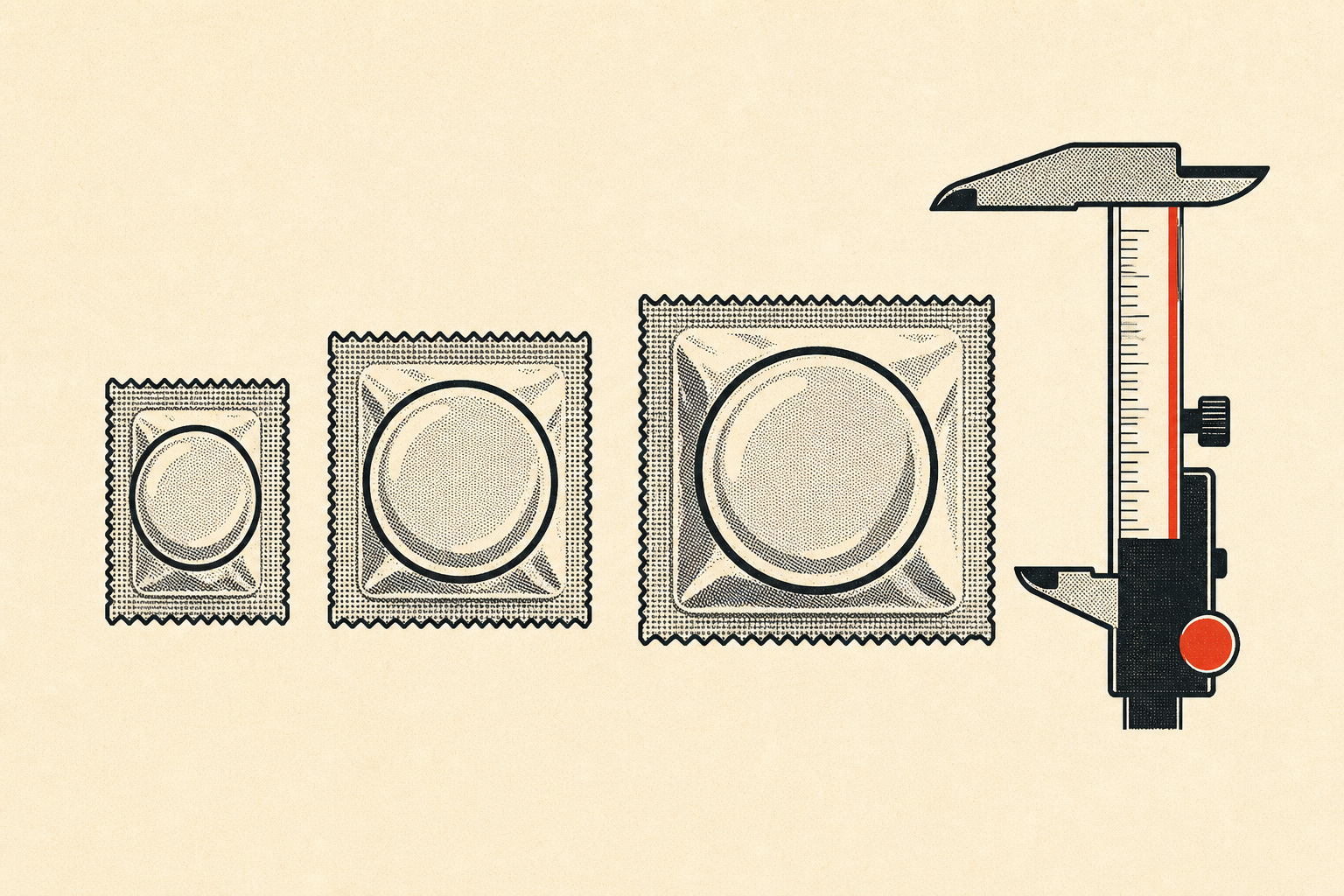
The drugstore wall is a lie. “Comfort,” “pleasure,” “ultra-thin,” a dozen adjectives that tell you nothing about whether the thing inside will actually fit. Here’s the part they never print on the front: the most useful thing your measurements give you isn’t a percentile or a bragging right. It’s the one condom that stays on, stays intact, and lets you forget you’re wearing it. That comes down to a single number almost no man has ever bothered to measure.
Length is a distraction. Girth runs the show.
You assume condom size is about length. It isn’t. Length only decides how far the latex unrolls down the shaft, and standard condoms are built with slack to spare. Most unroll to 18 or 19 cm, well past the average erect length of 13.12 cm (Veale 2015, SD 1.66). Unless you’re sitting at the very top end, length almost never makes a condom fail.
Girth is the dimension that decides fit. Circumference sets how tight the latex sits, how far it stretches, whether it grips or slides off. The average erect girth in that same Veale review was 11.66 cm, and that one number is why “standard” condoms work for nearly everyone: they’re engineered around exactly that range. If length is all you’ve ever watched, you’ve been staring at the wrong dial.
The reason is pure mechanics. A condom that runs a touch short leaves a centimeter of bare shaft near the base. Not ideal, but the business end stays covered and the thing stays put. Get the girth wrong and there’s no slack to forgive it. Too narrow, the latex fights your skin the whole time. Too wide, it never grips at all. The tube has exactly one dimension it can’t fake, and that’s the one going around.
Turn your circumference into a number you can shop with
Condoms aren’t sold by circumference. They’re sold by nominal width — the lay-flat width when you press the condom flat, roughly half your circumference. The math is grade-school:
nominal width (mm) ≈ girth (cm) ÷ 2 × 10
An erect girth of 12 cm gives a nominal width of about 60 mm. Manufacturers don’t label it quite that way, because the latex has to grip, not hang loose. The printed number runs a hair narrower, which is why brands cluster their “standard” line around 52 to 54 mm. You don’t need lab math in your head. You need the right category. Our condom-size calculator runs the conversion and tags you snug, standard, or large, no guessing.
One catch. Nominal width isn’t standardized across brands the way a shoe size roughly is. One company’s “52 mm” can fit noticeably differently from another’s, because rubber elasticity and roll shape vary. Treat the millimeter figure as a starting category, not a guarantee. If your first box in the right band still feels slightly off, swap brands at the same width before you jump a whole size. You may have just hit a stiffer or thinner latex than your skin likes.
A rough map of the three categories
Here’s the lay of the land in plain numbers:
| Erect girth | Category | Nominal width |
|---|---|---|
| under ~11 cm | Snug / close-fit | ~49–51 mm |
| ~11–12.5 cm | Standard | ~52–54 mm |
| over ~12.5 cm | Large / XL | ~56–60 mm |
Most men land squarely in standard, right on that 11.66 cm average. If that’s you, here’s the unglamorous truth: the ordinary box on the shelf is your best buy. “Large” is a label, not an upgrade. And if you came out under 11 cm, snug-fit isn’t a demotion. It’s the condom that’ll actually stay put. The spread of normal is enormous. Roughly 90% of men fall between 10.7 and 15.5 cm in erect length, and girth varies just as widely, so nearly everyone drops cleanly into one of these three buckets. If your number feels weird, it almost certainly isn’t. See is 5 inches normal for how little the “average” really means, or how rare is my size to see exactly where you land.
The cutoffs in that table are soft, too. Nobody flips from standard to large the instant they clear 12.5 cm. Measure 12.4 cm one day and 12.7 cm the next and you haven’t changed categories. You’ve discovered that a tape measure has a margin of error, especially on a body part that won’t hold still. Sitting right on a boundary? Buy a small box of each and let comfort cast the deciding vote. The number gets you to the right shelf. Your own skin picks the winner.
What goes wrong when the fit is off
A bad fit fails in two opposite directions, and you want to know which one you’re risking.
Too tight is the obvious one. It pinches, it’s uncomfortable, and overstretched latex sits under more strain, which makes a break likelier. It can also dull sensation enough that men ditch condoms entirely, a quiet failure that never shows up in breakage stats but counts just as much. A too-tight condom announces itself fast: a constricting ring at the base, a band of numbness, an erection that fades because the squeeze acts like a tourniquet. None of that is a stamina problem. It’s a sizing problem wearing a stamina problem’s clothes.
Too loose is sneakier, and arguably more dangerous. A condom that’s too wide can slip mid-act or, worse, come off on withdrawal. Men underestimate slippage because a condom that feels fine can still be too roomy to grip. The tells: the reservoir tip balloons or wrinkles, the rolled ring slides down a centimeter without you touching it, or you finish and find it bunched instead of snug. Stuck between two sizes? Size down. A condom that grips is doing its one job.
How to test a box before you trust it
You don’t have to wait for a real-world moment to learn whether a size works. Roll one on at home and pay attention for thirty seconds. The base ring should sit firmly without carving a red mark into your skin. The body should lie smooth against the shaft. A little give is fine; loose folds and air pockets are not. Run a finger down the length. If you can slide the latex back and forth over the skin, it’s too wide. If putting it on felt like forcing a swim cap onto a basketball, it’s too narrow.
Two gut-checks settle most cases. Once it’s on, give the base a gentle tug. A correct fit resists and snaps back; a loose one creeps toward the tip. Then check whether the rolled rim leaves a deep groove after a couple of minutes. A faint line is normal; a painful welt means size up. Do this once per candidate box and you’ll know your size with more confidence than any chart can offer, because the only opinion that matters is your own anatomy’s.
Fit is what makes protection real
There’s a behavioral angle that’s easy to miss. A condom only works if you use it, and you’ll only keep using it if it doesn’t feel like a penalty. The research is consistent: men who report poor fit see more breakage and slippage, and are likelier to peel a condom off before sex is over or skip it next time. Comfort isn’t a luxury. It’s part of the protection. If you’re shopping fit seriously, start at condoms.
This is also where you separate insecurity from fact. If reaching for a “snug” condom feels like it says something about you, it doesn’t. Partners don’t weigh size the way men assume. In Prause’s 2015 preference study, women picking from a range of sizes clustered near the population average rather than skewing large, and girth mattered to them at least as much as length. The right-sized condom isn’t a confession. It’s the one that works. For more, does size matter, girth vs length, and what women prefer are worth your time.
Clearing up the size myths the box aisle encourages
The marketing primes a few bad assumptions, so let’s knock them flat. “Large” condoms aren’t a reward tier. They’re a fit category, and grabbing one you don’t need is how you invite slippage. Sizing up doesn’t add sensation either. What it adds is the risk of the whole thing coming off, which is the precise opposite of a good time.
On the other end, a snug or close-fit condom doesn’t imply anything is wrong with you. The smallest standard sizes exist because plenty of men measure below 11 cm in girth and deserve a condom that grips, full stop, including men whose erect length sits comfortably in the normal range. Measurements that look small in isolation are usually nothing of the kind once you see the full distribution; the average penis size page puts any single number in context. Genuine clinical smallness is rare. Micropenis is defined around 9.3 cm in stretched length and affects a tiny fraction of men, and it’s a medical category, not the everyday “am I normal” worry most readers carry. For the vast middle where nearly everyone lives, the only honest answer to “what size condom” is “whichever one you measured into.”
Measure once, then you’re done
Your body isn’t going to switch brands on you, so this really is a measure-once task. Take your girth at the thickest part of the erect shaft. The how to measure guide walks through doing it the same way every time, because a tape held at an angle, or laid at the wrong spot, can throw you off by a whole category. Run that number through the condom-size calculator and note the nominal width.
Then ignore the adjectives and buy by that number. “Comfort,” “pleasure,” and “ultra-thin” describe texture and thickness, not fit. A snug condom and a large condom can both be ultra-thin. Once you know your width, pick any feature you like inside your size band. Want to see where the underlying numbers come from instead of taking them on faith? The methodology page lays out the sourcing. But for the practical question — which box do I grab? — one measurement settles it for good. Most men spend years guessing. Five minutes with a tape crushes that.
FAQ
Does length ever matter for condom fit? Rarely. Standard condoms unroll to about 18–19 cm, well past the 13.12 cm average, so length only becomes a factor at the extreme top end. Even then, a shorter roll just leaves the base uncovered rather than causing failure. Girth decides whether a condom grips or slips.
I’m right between two sizes. Which do I pick? Size down. A condom that grips a little more firmly does its job; one that’s even slightly too roomy can slip off on withdrawal. Better still, buy a small box of each and let comfort decide. Boundary numbers are soft, and a tape measure has its own wobble.
Will a bigger condom feel better? No. It’ll feel looser and risk coming off, the opposite of what you want. Sensation comes from thickness and texture (ultra-thin, ribbed, and so on), not from buying up a size. Match the width to your girth, then pick whatever feature you like within that band.