Does Size Matter? What the Research Actually Says
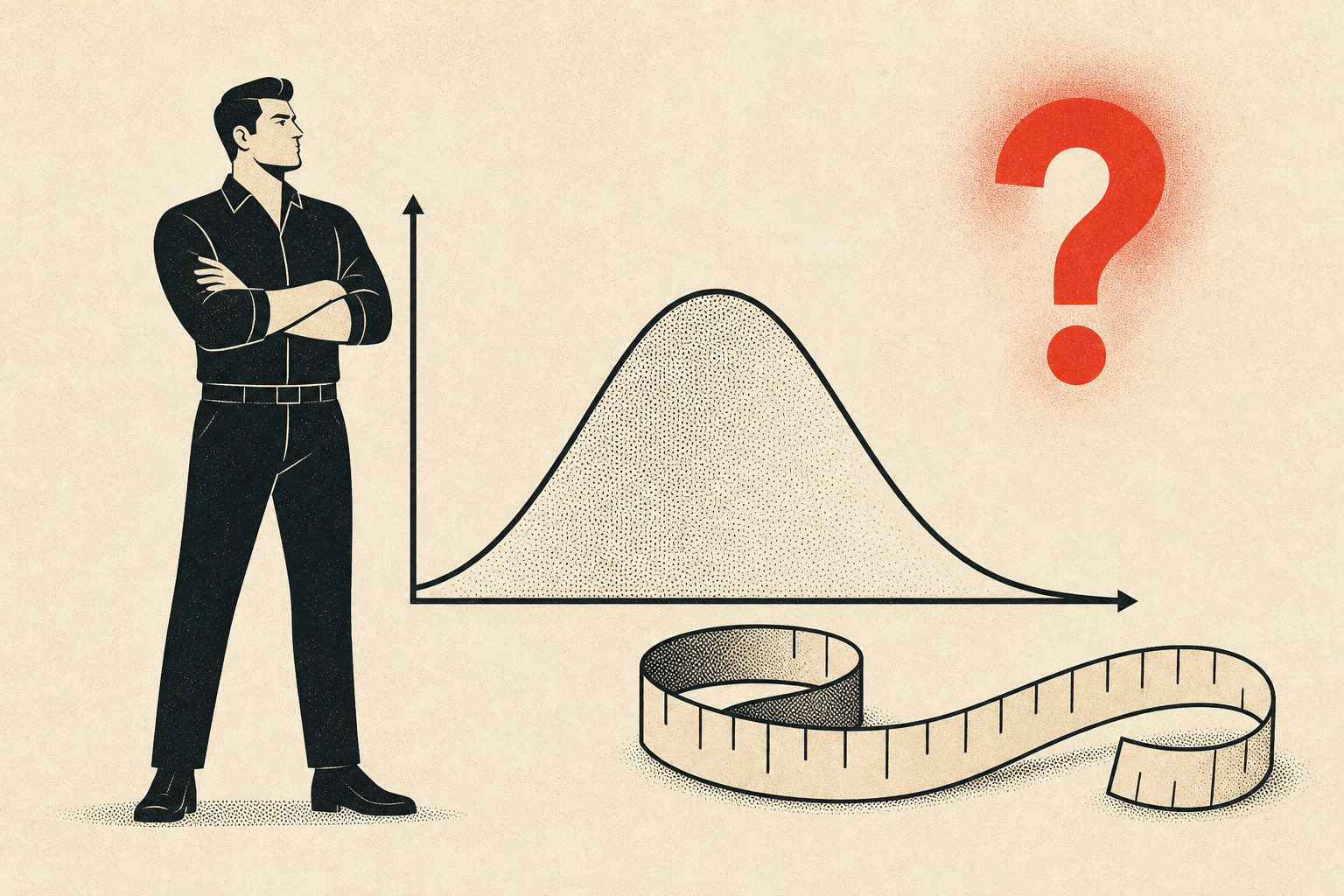
A man walks into a urologist’s office certain something is broken. The tape comes back parked dead center of the bell curve. That scene plays out week after week, and it tells you everything: the worry is real, the problem almost never is. So here is the blunt, research-backed verdict. Size matters far less than the internet screams, and it matters in ways you’d never guess.
The only numbers that anchor any of this
Everything downstream rides on real measurements, so start there. The gold standard comes from Veale and colleagues, who in 2015 pooled data from more than 15,000 men measured by clinicians under standardized conditions. Average erect length: 13.12 cm, standard deviation 1.66. Average erect girth: 11.66 cm. That tiny standard deviation is the whole story, because it means the curve is tight. Roughly 90% of men land between about 10.7 cm and 15.5 cm erect. Micropenis, a real clinical category, sits under about 9.3 cm and is genuinely rare. So if you’ve spent years convinced you’re an outlier, the math is quietly on your side. Almost everyone clusters near the middle, and the far ends are nearly empty. Drop any number into the calculator and watch it turn into a percentile, so you’re measuring yourself against data instead of whatever your brain cooked up at 2 a.m.
Get concrete about what that standard deviation buys you. To fall outside the 10.7–15.5 cm band, you have to be more than two standard deviations from the mean in one direction or the other. That’s the same statistical rarity as being unusually tall or short, the kind of thing that makes someone the tallest guy in the room, not a medical anomaly. Picture a hundred men lined up by size. The man at position 50 and the man at position 60 are, for every purpose that matters in bed, identical. The gap between the 30th man and the 70th is about a centimeter and a half. Less than a thumbnail. The differences men agonize over are usually smaller than the margin of error on a bathroom ruler, which brings us to the next problem.
Why the ruler lies, and how to make it stop
A number is only worth trusting if it was measured honestly, and most aren’t. Self-reported figures run high, for reasons nobody finds shocking. Method matters more than people expect: bone-pressed length and a fully rigid erection explain most of why clinic numbers and bathroom numbers fight. If you’re going to measure, measure right. Use the technique in how to measure, and read how accurate are penis size studies before you trust a single stat you found online.
The biggest source of phantom centimeters is the fat pad. There’s a layer of tissue at the base, and how hard you press the ruler into it swings your reading by one to two centimeters, more on a heavier frame. Clinicians press firmly to the pubic bone every time, which is why “bone-pressed” is the only number worth comparing against study data. The figure you get measuring loosely from the surface of the skin is real, but it’s a different measurement, and stacking it against a bone-pressed average is comparing two rulers and calling the gap a defect. Three other things quietly inflate or deflate a reading: temperature (cold shrinks, and not subtly), the angle of the ruler, and whether the erection is fully rigid or merely present. Measure cold, half-hard, ruler shy of the bone, and you can manufacture a “problem” that vanishes the second you measure properly. Take a couple of readings on different days under the same conditions and average them. One bad measurement on a bad day has talked more men into despair than any partner ever has.
What partners say when you ask them properly
The ruler is the boring part. The real question is what partners actually prefer, and that research is unusually solid. Most surveys ask people to recall a number, which is about as reliable as asking what they ate three Tuesdays ago. Prause and colleagues sidestepped the whole mess in 2015: they handed women a set of 3D-printed models in different dimensions and let them pick. Strip out the guesswork and a few patterns hold firm. Preferences land slightly above average, never at the extremes. Girth matters at least as much as length, partly because sensation concentrates in the outer third, something we dig into in girth vs length. Context shifted things too. What women picked for a one-night encounter ran a touch larger than what they picked for a long-term partner, where the slightly-above-average choice pulled back toward plain average.
That context effect deserves a hard look, because it quietly demolishes the whole “bigger is the goal” premise. The bump toward larger sizes showed up only for novelty, the imagined one-off. The thing people optimize for in a partner they’ll wake up next to is not maximal size. It’s comfort, repeatability, and fit. If your anxiety is about a long-term relationship, the research is pointing straight at average and telling you that’s the answer it was hunting for. What women prefer backs it up.
There’s a second pattern, and it’s the heavyweight. Survey after survey, the large majority of women report being satisfied with their partner’s size, and that share dwarfs the share of men satisfied with their own. Sit with that gap. It’s the entire article in one statistic. The dissatisfaction lives almost entirely in men’s heads, fed by porn, locker-room math, and the optical fact that staring straight down at yourself is the least flattering angle on earth. The person you’re anxious about impressing is, statistically, already fine.
Where size genuinely does matter
None of this makes size irrelevant, and pretending otherwise would be its own lie. The extremes can affect comfort and make some practical things harder. Condom fit is the obvious one. Too tight or too loose and you’ve wrecked both safety and sensation, and the fix isn’t medical, it’s buying the right product instead of grabbing whatever sits at eye level in the pharmacy. The condom size guide covers the matching. There’s also a real clinical floor at the small end, and if that’s a specific fear rather than a vague one, what is a micropenis lays out where the line sits and what crossing it does and doesn’t mean. But here’s the finding that torches the cultural script: bigger is not reliably better. Past a fairly ordinary threshold, comfort and technique take over, and the data flatly refuses to reward the extreme.
The large end carries its own underrated downsides, which never make the mythology. Discomfort during sex gets reported more often with larger partners than smaller ones, certain positions go off-limits, and plenty of women describe well-above-average size as something to manage rather than enjoy. The cervix doesn’t care about anyone’s ego. This is the part the comparison machine hides: there’s a usable middle range where things simply work, and on either side you start trading comfort for a number that impresses nobody who matters. The reason “average” keeps winning these studies isn’t politeness. Average is, functionally, the size human bodies are built to accommodate without anyone having to think about it.
What actually moves the needle in bed
If size is mostly settled for you, and for roughly nine men in ten it is, the real question is where to spend your attention instead. The honest answer: the variables that decide whether sex is good are almost entirely the ones you can change. Communication tops the list. Knowing what a specific partner likes, and being relaxed enough to ask, beats any anatomical advantage. So does foreplay, which does more for a partner’s experience than a centimeter ever could. So does plain confidence, which runs its own feedback loop. Anxiety about size is a leading cause of performance trouble, which then gets misread as more proof that size is the problem. It almost never is.
Run a clean experiment on yourself. The next time the worry surfaces, clock what triggered it. It’s almost never a partner saying anything. It’s a scene in a film, a comment online, a glance in a locker room, a thought at 2 a.m. Input from everywhere except the one place that counts. Real partners aren’t standing there with a tape measure and a chart of national averages. They’re responding to attention, enthusiasm, and whether you seem present. None of that is on the ruler. Want a sense of where your number sits before you put the question down for good? Check it against the data and read how those numbers get collected in the methodology. Once you see how the sausage is measured, the scary statistics lose their grip.
Where the fear gets manufactured
The fear didn’t come from nowhere, so it helps to see the factory. Porn selects for outliers and sells them as the baseline, which is like studying human height by watching the NBA. The downward viewing angle shrinks your own anatomy and inflates everyone else’s by comparison. And a startling amount of adult life comes down to weighing one quiet private number against a loud public myth. Once you notice the comparison is rigged, it loses its teeth. Here’s the cruel twist clinicians see constantly: the men in the deepest distress are usually the ones measuring dead average. The worry tracks self-image, not the tape.
The same distortion runs through every channel that taught you what “normal” looks like. Locker-room glances catch other men flaccid and at an angle; you catch yourself foreshortened from above; the brain files the mismatch as a deficit. Marketing for pills, pumps, and “enhancement” anything has a direct financial stake in keeping you convinced there’s a gap to close. The whole business model is manufactured inadequacy, and it works because the product never has to deliver, only the anxiety does. Even casual jokes do work, framing size as a punchline so reliably that men internalize the scorekeeping without ever having been scored. The antidote isn’t a pep talk. It’s data, and the data is boring in the most reassuring way: most men are average, average is what partners are satisfied with, and the gap you feel is between you and a myth, not you and a real person.
So where does that leave the original question? Right about here. For a good sex life, size is one of the least important variables you can name, and it’s the one you can change the least. Attention, communication, confidence, skill, all of those matter more, and every one of them is learnable. A number on a ruler is not. If you’re in the normal range, and the calculator will almost certainly tell you that you are, the single most useful move is to stop auditing the number and start tending to the things a partner actually notices. The research keeps landing in the same unglamorous, kind place: the thing you’ve been losing sleep over is, for nearly everyone, already solved.
FAQ
Is there an average I should be comparing myself to? Yes, and it’s narrower than you think. Veale’s 2015 data puts average erect length at 13.12 cm and girth at 11.66 cm, with about 90% of men falling between 10.7 and 15.5 cm. Run your own bone-pressed measurement through the calculator for a percentile instead of eyeballing it.
Do partners actually prefer larger? Slightly above average for a one-time encounter, drifting back toward plain average for a long-term partner. That’s the Prause 2015 finding. More to the point, the share of women satisfied with their partner’s size is large and consistently bigger than the share of men satisfied with their own. The dissatisfaction is mostly self-generated.
Could I be measuring myself wrong and panicking over nothing? Almost certainly, if you measured cold, loosely, or only once. Fat-pad pressure alone can swing a reading by a centimeter or two. Follow how to measure, bone-pressed, fully erect, averaged over a couple of attempts, before you trust any number, including the ones that worried you.