Penis Size Compared to Everyday Objects: The Honest Reality Check
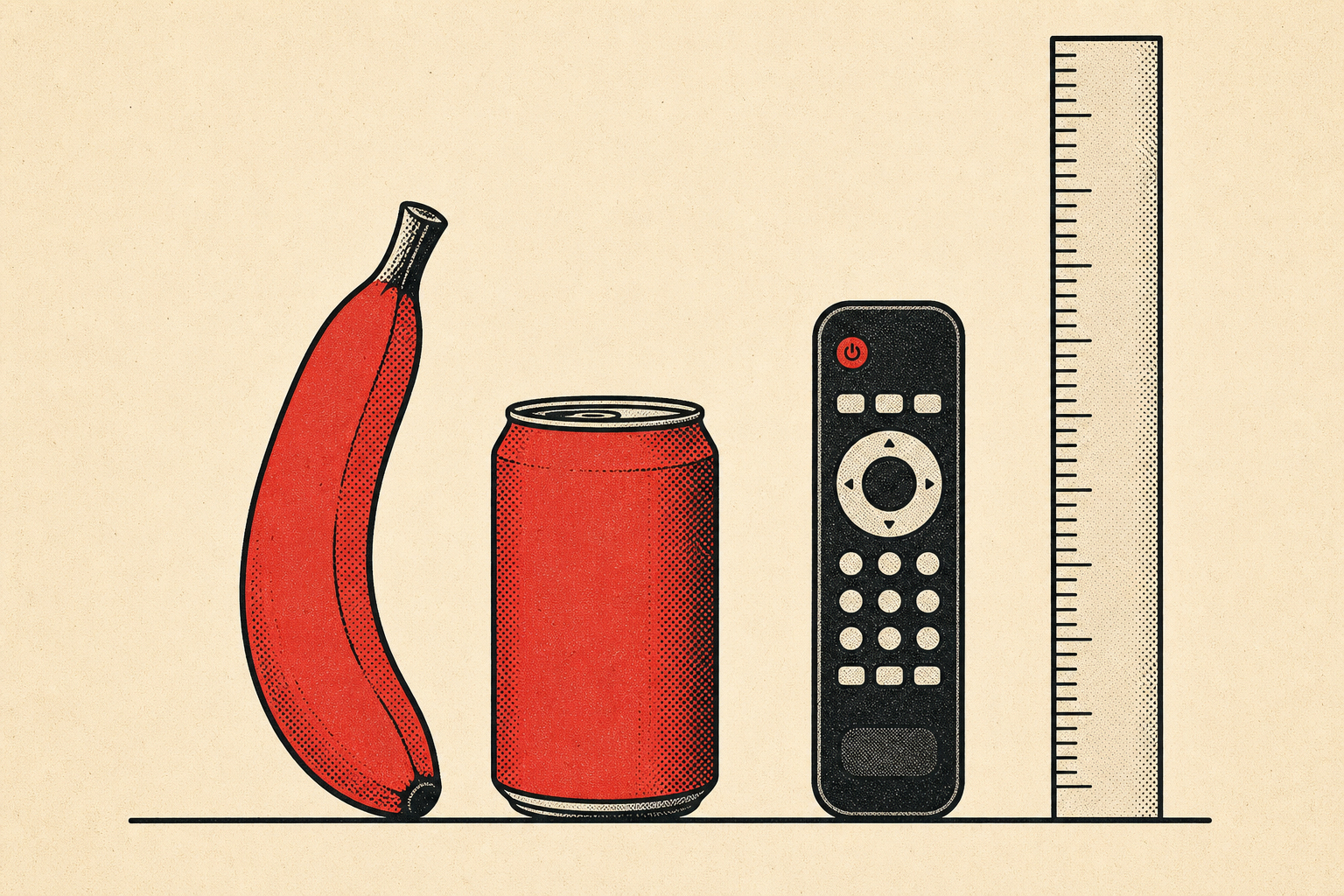
A number on a ruler means nothing until you put it next to something real. “Five point one six inches” is a abstraction. A soda can in your fist is not. So forget the chart — we’re translating the best data on earth into objects you’ve held a thousand times: a banana, a credit card, a AA battery, the phone in your pocket. Then you’ll see exactly where the average lands.
The anchor for all of it is the biggest clinician-measured study ever run: Veale and colleagues (2015, BJU International), who pooled 15,521 men measured by trained staff — not tape measures wielded hopefully on a bathroom floor. The average erect penis in that data is 13.12 cm, or 5.16 inches, with average girth of 11.66 cm / 4.59 in. Lock those two numbers in. Everything below is just dressing them up in things you recognize.
The average erect penis, in objects you own
Picture a standard 330 ml soda can. It stands 11.5 cm tall. The average erect penis, at 13.12 cm, clears it — about a centimeter and a half poking up past the rim. That single image beats every chart on the internet. Sit with it.
A few more from the kitchen and the wallet:
- A banana. The eternal comparison, and it’s rigged. A supermarket banana runs roughly 18-20 cm along the outer curve, so it’s flat-out longer than average. The straight edible part, closer to 15 cm, lands in the right neighborhood. If the banana always felt like it set a brutal bar, that’s because it does.
- A credit card, turned for girth. A card’s long edge is 8.56 cm. Average erect girth — the measurement around the shaft — is 11.66 cm. So you beat one card edge comfortably but fall short of the diagonal, about 10 cm. Wrap the card around and it wouldn’t quite close.
- A AA battery. 5 cm tall, almost exactly one inch of penis each. Stack two and a half to two and two-thirds of them and you’re at average length.
- A smartphone. Most modern phones run 14.5-16 cm tall — which makes the average erect penis shorter than the thing in your pocket by a couple of centimeters. People are floored by this one, and that shock tells you exactly how warped the baseline expectation has gotten.
- A Sharpie marker. A classic permanent marker is about 14 cm capped. Average length lands just under it.
Girth deserves its own object, because length hogs the spotlight it didn’t earn. Average erect girth of 11.66 cm works out to a diameter of roughly 3.7 cm — close to the width of a ping-pong ball (4 cm). Around the shaft you’re in 20p-coin-circumference territory. We get into why girth quietly outranks length over in girth vs. length.
What one inch looks like, object by object
Here’s the part nobody tells you: the entire bell curve fits inside a sliver. Roughly 90% of men land between 10.4 cm and 15.9 cm erect — about 4.1 to 6.2 inches. That’s a two-inch window holding nine men out of ten. Two inches.
Which means an inch is everything in this game. Hold one:
- A AA battery (5 cm) is just under two inches.
- A standard paperclip, opened straight, runs about an inch.
- Three stacked quarters come to roughly an inch wide.
- A US quarter’s diameter (2.4 cm) is just under an inch.
Now drop the band onto those inches. The 5th percentile sits at 10.4 cm (4.1 in), the 95th at 15.9 cm (6.2 in), and the median — the literal middle man — at 13.1 cm (5.2 in). Slide from the 25th percentile (12.0 cm) to the 75th (14.2 cm) and you’ve moved barely two centimeters. Less than half a battery separates the floor of the “average” range from the ceiling. Want to spin the dial and watch any number snap to scale? The size visualizer renders it against objects like these in a couple of clicks.
”Is six inches big?” — the inch-by-inch reality check
This is the question hiding behind all the others, so let’s settle it with percentiles instead of vibes.
- 4 inches erect sits around the 4th percentile.
- 5 inches is roughly the 40th — just below the median, squarely normal.
- 5.5 inches lands near the 70th.
- 6 inches is the 90th percentile. About one man in ten. Genuinely above average, not a myth — but not “huge” either.
- 7 inches is the 99.7th percentile — about one in 400 men.
- 8 inches is rarer than one in 10,000.
Read that list twice. It’s the antidote to internet measurement culture. The “average” you’ve absorbed from forums and films is actually the 90th percentile of reality. Six inches feels like a floor in locker-room talk and is in fact the ceiling of the top ten percent. Want the full statistical picture? The statistics page and our how-big-is-big tool both go deeper, and you can check exactly how rare your size is. And if you came here wondering whether five inches is fine: is 5 inches normal? Short version — it’s the 40th percentile. It’s normal.
Why home measurements never match the can
This is where self-comparison goes off the rails. The research figure of 13.12 cm is bone-pressed: the measurer drives the ruler firmly into the pubic bone, compressing the fat pad at the base, then reads to the tip. That’s BPEL — bone-pressed erect length.
What you measure casually at home, ruler resting on top of the skin, is non-bone-pressed (NBPEL), and it reads about 1 to 2 cm shorter depending on how much padding sits at the base. Same penis, different number. So if you laid yours next to a soda can and came up short of the research average, you were probably measuring a different thing than Veale’s team did. Press the ruler in and compare like with like. Our how-to-measure guide walks you through a clean, repeatable number, and the methodology page lays out exactly what the study captured. Girth doesn’t care about any of this — there’s no bone to press against when you’re measuring around.
The objects lie a little: flaccid, growers, and showers
One more catch with the can comparison: most of the day, nobody’s at 13 cm. Average flaccid length is 9.16 cm (3.6 in) — roughly two AA batteries, and clearly shorter than that soda can. Flaccid girth averages 9.31 cm.
And flaccid size is a famously terrible predictor of erect size. Some men barely gain going from soft to hard (the “showers”); others start small and roughly double (the “growers”). The soft banana on the counter tells you almost nothing about the hard one. There’s a genuinely fun grower vs. shower tool that estimates which camp you’re in, and flaccid vs. erect covers why the gap swings so wildly. The takeaway: never judge yourself — or anyone else — by the locker-room view. It’s measuring the wrong object.
What partners actually picture
Of every object here, this is the one to keep. When researchers (Prause and colleagues, 2015) had women pick preferences using 3D-printed models they could physically hold, the choices for a long-term partner clustered around 16.0 cm length and 12.2 cm girth — slightly above average on both, not wildly so. Two findings hit hard. Girth mattered at least as much as length, sometimes more. And most women reported being perfectly satisfied with their actual partner’s size.
That “slightly above average” preference works out to roughly the 90th-percentile length next to a barely-above-average girth: a real but modest edge, a handful, not a fire hydrant. The gap between what men fear is expected and what’s actually preferred is small enough to fit inside a couple of AA batteries. Whether any of it changes outcomes is a different question, and we take it head-on in does size matter?
A note on the outliers
Two ends of the curve deserve a straight word. At the low end, micropenis is a precise clinical term — an erect length under about 9.3 cm — and it applies to roughly 0.6% of men, fewer than one in a hundred. It’s far rarer than anxious self-diagnosis suggests; we cover the actual definition in what is a micropenis. At the high end, the eight-inch banana of legend (rarer than one in 10,000) is real, but benchmarking yourself against it is like measuring your salary against a lottery winner’s.
And ignore any chart claiming to show your “size by single year of adult age.” Growth wraps at the end of puberty, around 17 to 19, and size stays essentially fixed for the rest of your life. Those smooth year-by-year adult curves floating around the internet are, almost without exception, invented. The real story — what changes and what doesn’t — is in average penis size by age. National rankings have the same disease: they come from self-reported data and aren’t representative. Browse them for fun on average penis size by country, but don’t take the leaderboard to heart.
FAQ
Is the average penis really shorter than a banana? Usually, yes. A supermarket banana runs about 18-20 cm along the curve, while the average erect penis is 13.12 cm (5.16 in). The banana is a flattering yardstick — it’s closer to the 99th percentile of human length than to the average. A soda can (11.5 cm) is the honest comparison.
Why does my measurement come up shorter than 5.16 inches? Most likely because the study figure is bone-pressed (BPEL), ruler driven into the pubic bone, while a casual home measurement on top of the skin (NBPEL) reads 1 to 2 cm shorter. Measure the way the researchers did and the gap usually closes. See how to measure for the technique.
What’s a more useful comparison than length alone? Girth, honestly. Average erect girth is 11.66 cm around, and the preference research weighted girth at least as heavily as length. The practical payoff: your girth, not your length, decides your condom size. Start there.